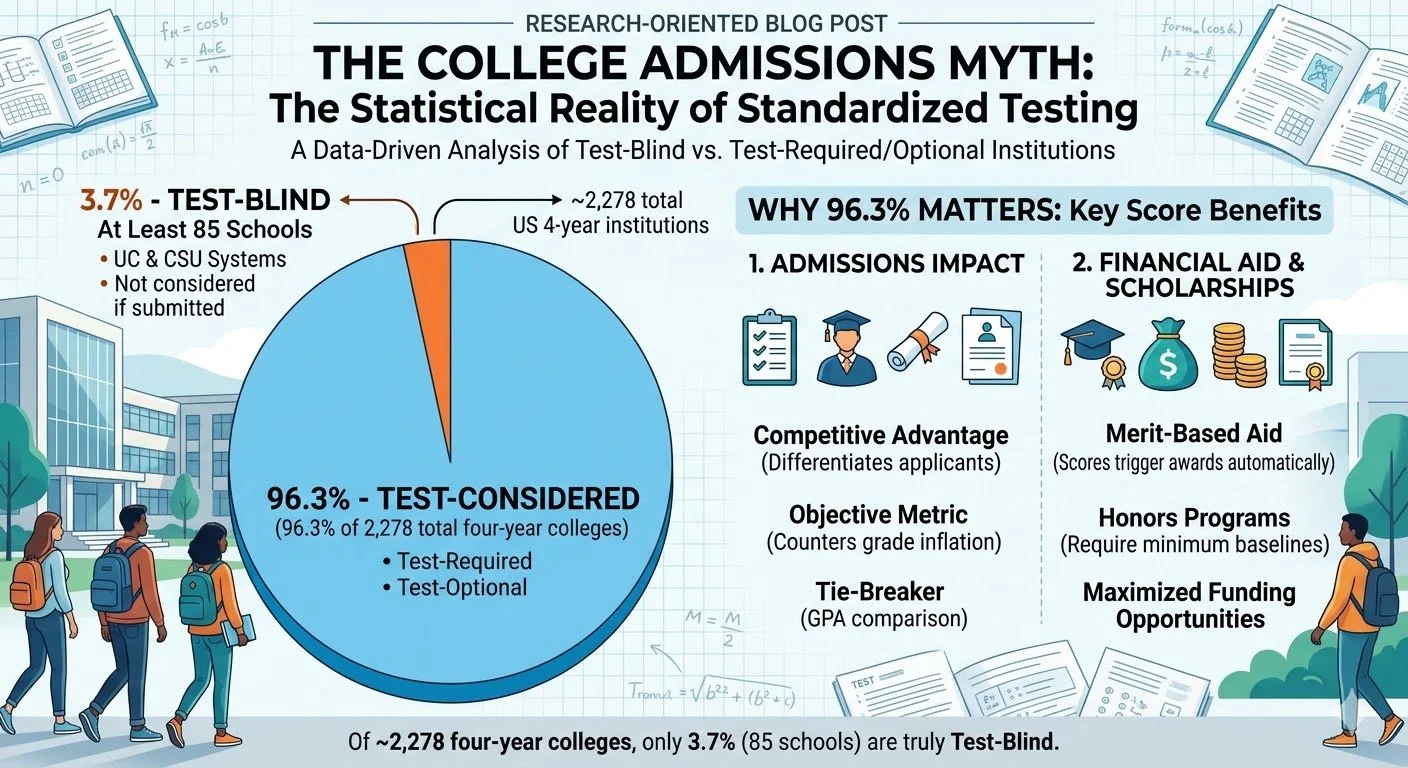
For prospective college applicants, standardized test scores remain one of the most statistically significant levers for maximizing admission probabilities and securing merit-based financial aid. Despite prevailing public narratives suggesting the obsolescence of the SAT and ACT, empirical data reveals a contrary reality: at 96.3% of four-year institutions, standardized test scores continue to play a structural role in the evaluation process. While it is understandable that applicants may wish to forgo these examinations to streamline the application process, an analysis of current institutional policies demonstrates that complete disregard for test scores is a statistical anomaly rather than the academic norm.
The Data: Prevalence of Test-Blind Institutions
Currently, approximately 85 out of the roughly 2,278 four-year colleges and universities in the United States operate under a strictly test-blind (or test-free) policy. This equates to roughly 3.7% of four-year institutions.
A test-blind policy mandates that admissions committees will not consider ACT or SAT scores under any circumstances, even if an applicant submits them. The most notable implementations of this policy are within the University of California (UC) and California State University (CSU) systems (for now). For applicants exclusively targeting these specific public systems, standardized testing holds no functional utility.
However, from a statistical standpoint, this leaves approximately 96.3% of four-year institutions where standardized test scores continue to function as active data points.
The Function of Test Scores in the Remaining 96.3%
At the vast majority of institutions—including those operating under "test-optional" frameworks—standardized test scores retain significant value for two primary reasons: admissions evaluation and financial aid distribution.
1. The Mechanics of Test-Optional Admissions
The designation of "test-optional" indicates that scores are not a mandatory application requirement, but it does not preclude their consideration. In these environments, submitted scores are actively evaluated and can provide a distinct competitive advantage.
Objective Benchmarking: In the context of documented, widespread secondary-school grade inflation, standardized tests provide admissions officers with an objective, standardized metric to assess academic readiness across disparate educational environments.
Comparative Advantage: When evaluating applicants with comparable grade point averages and extracurricular profiles, a high standardized test score serves as a differentiating data point that can positively influence the final admissions decision.
2. Merit-Based Aid and Scholarship Allocation
Perhaps the most critical function of standardized test scores at the remaining 96.3% of institutions relates to institutional funding. Even when an institution is test-optional for the purposes of admissions, test scores are frequently utilized as primary criteria for financial distribution.
Grid-Based Scholarships: Many universities employ formulaic scholarship grids where specific combinations of GPA and SAT/ACT scores automatically trigger predetermined, non-need-based financial awards.
Honors Programs and Specialized Funding: Admission into institutional honors colleges—which frequently provide targeted grants, priority registration, and specialized housing—often requires students to meet established baseline thresholds for standardized test scores.
Conclusion
The test-blind policies at UC and CSU are statistical outliers. For applicants evaluating the utility of SAT or ACT preparation, the data indicate that standardized tests remain highly relevant. For over 96% of four-year institutions, submitting strong test scores continues to be a strategic mechanism for maximizing both admissions probabilities and merit-based financial aid.