
Every fall, families sit down with a college list and write one number next to each school.
The admit rate.
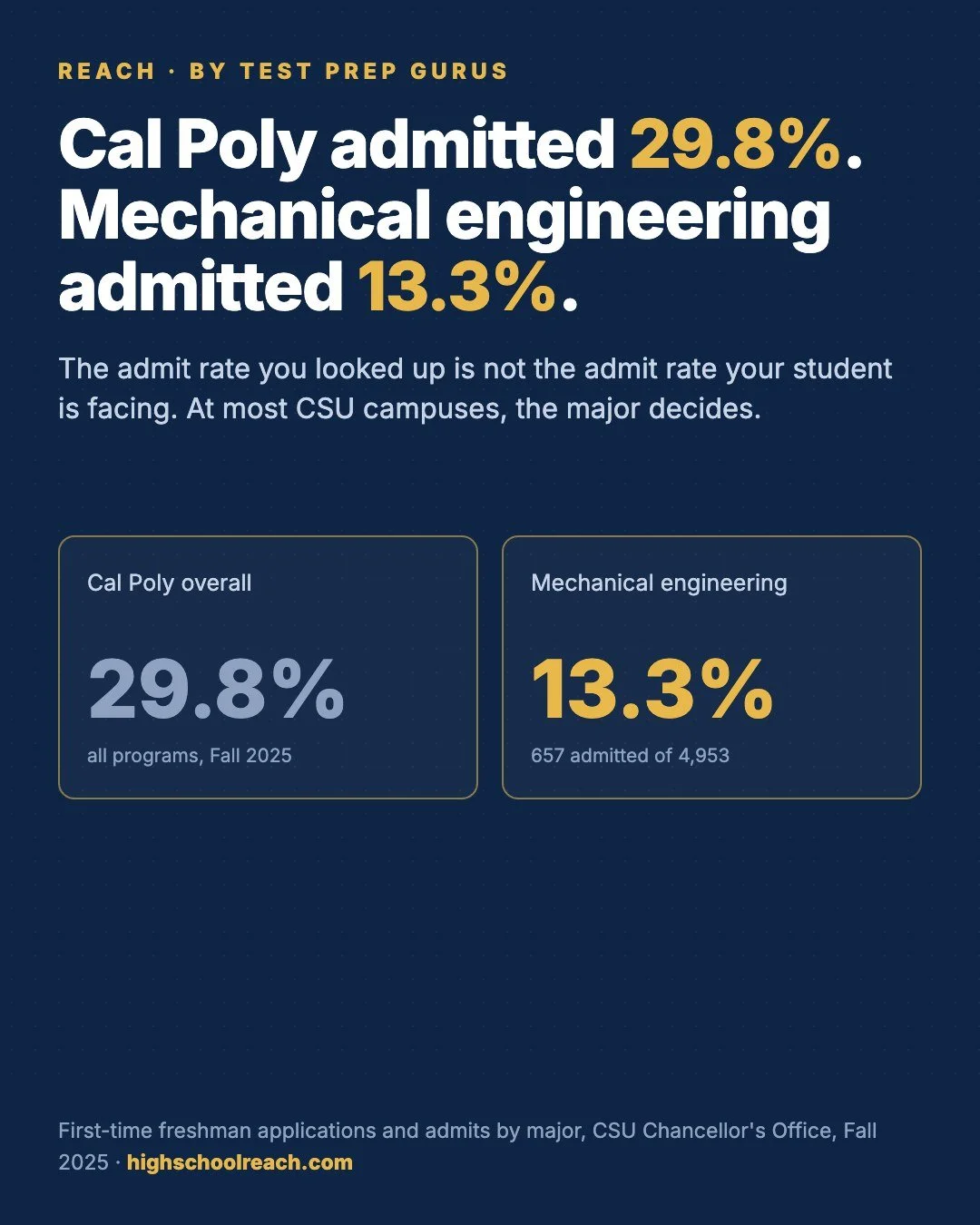
It feels like the right number. It’s published, it’s easy to find, and it sorts the list into reaches and targets in about ten minutes. For Cal Poly San Luis Obispo, that number is 30%.
Now look at the major.
Mechanical engineering at Cal Poly admitted 13.3% last fall. Not 30%. Four thousand nine hundred fifty-three students applied to that program, and 657 got in. Aerospace engineering admitted 12.0%. Political science, on the same campus, in the same year, admitted 34.7%.
San Diego State is the one that stops people. The campus admitted 34%. Nursing pre-licensure admitted 3.5% — 8,620 applications, 306 offers. One-tenth of the campus number, at the same front door.
That is a twentyfold difference inside one university, and the campus rate splits the difference and tells you nothing.
Here’s why this happens. A campus admit rate is an average across programs that have almost nothing to do with each other. Nursing has a fixed number of clinical placements and a national shortage of applicants who can fill them. Computer science expanded. Political science did not see the surge that engineering did. Average those together and you get a number that describes the university’s paperwork, not your student’s odds.
What to do about it
If your student has already decided what they want to study — and most rising seniors have, at least directionally — the campus rate is close to useless. Use the program rate.
Two things to know before you do. First, every program at Cal Poly and San Diego State is impacted, a CSU term meaning the campus adds admission requirements beyond the CSU minimum: a higher GPA bar, specific coursework, or priority for local students. Treat impacted majors as more competitive than the campus rate suggests, always.
Second, a rising admit rate usually means fewer applications, not lower standards. Don’t read a jump as an opening.
We put admit rates by major on all 23 CSU campus pages — applications, admits, the rate, and where that rate stood in 2021 — using data from the CSU Chancellor’s Office. It’s free, and it stays that way.
A note on the numbers: the by-major figures are Fall 2025, straight from the CSU Chancellor’s Office. The campus-wide rates are the federally reported figures published by each university. We’ve kept them separate on purpose, because the whole point is that the two don’t tell you the same thing.
Look up either campus on our research site: Cal Poly San Luis Obispo, or San Diego State.
If your student’s list has a CSU on it, look up the major before you finalize anything. It takes a minute, and it changes the plan more often than you’d think.
We publish the underlying data and the full campus-by-campus tables on our research site, High School Reach: https://highschoolreach.com/blog/admit-rate-by-major-csu