"I am Excited" -- How to Deal With Pressure Situations

Below you’ll find a trick that many top performers, athletes, and musicians use to perform at their peak under stress. We’ve taught it to hundreds of our 1-on-1 students to help them score higher on the ACT, SAT, APs, and any other tests they take.

At Test Prep Gurus we teach students how to raise their ACT and SAT scores so they can reach their goals for college and beyond.

It all starts with 3 steps:

  1. Complete mock ACT and SAT exams.

  2. Schedule a free 15-minute consultation to review your exam results.

  3. Create a 1-on-1 test prep plan to reach your goals for college and beyond.

ACT and SAT Experimental Sections

Both the ACT and SAT contain 20-minute experimental sections. These experimental sections do NOT count toward your score on either the SAT or ACT — they are used to calibrate the difficulty-level of questions for future test-takers.

ACT Details:

Students who take the ACT test will see a 20-minute experimental section as their “5th” section (right after the Science section). The experimental section does NOT count toward your score. Only test-takers who qualify for extra time are exempt from the section. ACT test-takers will encounter the experimental section just after the Science section, but still before their 40-minute essay. Please note that if you are applying to selective colleges, the essay should be considered “required”.

SAT Details:

Some students who take the SAT test will be randomly selected to take a 20-minute experimental section as their “5th” section (just after the Calculator Math section). The experimental section does NOT count toward your score. Only test-takers who qualify for extra time are exempt from the section. Please note that if you are applying to selective colleges, the essay should be considered “required”.

The SAT 'Adversity Score' is Dead!

There is big news in the world of college admissions and standardized testing!


1) The SAT 'Adversity Score' is dead

So, I was recording a video describing the absurdity of the SAT's new adversity score--

Literally, I was in the middle of this sentence, "...as though something as nuanced and complicated as adversity could be boiled down to a single number..." when one of my staff walked in to inform me that the College Board (makers of the SAT) had decided to abandon the ill-advised adversity score.


There are many steps that we can take to address education inequality in America. The College Board's PR stunt to address education inequality with an oversimplified standardized score was not going to help. That the College Board is abandoning the score is good news for students everywhere.

The adversity score will be replaced with "Landscape." This new tool will allow families to see the same information about their high schools and neighborhoods that colleges see. We applaud this added transparency.

I will have more to say on this topic as Landscape is rolled out this admissions season--


2) In 2020 the July test date for the ACT is coming to California

This is good news for Californians who need this test date.

Two things to keep in mind--

*there is little time to prepare for this exam after the end of the school year. For this reason, September will continue to be the optimum official exam for the majority of students who engage in test preparation during the summer.

*you'll want to register early. There will be significantly fewer testing sites available during the summer, so they will quickly fill up.


3) This year the cut-off for California's national merit semi-finalists is 222

It looks like the cut-off for national merit semi-finalists dropped by a point this year in California. Congrats to our students who made the cut! This is a state-by-state competition, so surviving the cut in a high-population state like CA is a huge achievement!!


As always, our team is here to help if you need:

mock ACT or SAT exams

referrals for a private college counselor

1-on-1 instruction to maximize your ACT or SAT scores


Perfect Score!!!

Junior at Orange Lutheran High School works with Test Prep Gurus and earns a perfect score on the ACT!!!!

From the student’s proud mother: "We have some good news to share with you. She earned a perfect 36 on her ACT thanks to your solid training!"

At Test Prep Gurus we teach students how to raise their ACT and SAT scores so they can reach their goals for college and beyond.

It all starts with 3 steps:

  1. Complete mock ACT and SAT exams.

  2. Schedule a free 15-minute consultation to review your exam results.

  3. Create a 1-on-1 test prep plan to reach your goals for college and beyond.


College Admissions Cheating Scandal is Alarming and Disgraceful

Nick Standlea weighs in on the college admissions scandal.

Background info: In the largest college admissions scam ever prosecuted, wealthy parents, Hollywood actresses, coaches and a college consultant have been accused of carrying out a nationwide fraud to get students into prestigious universities. The scheme had two major pieces. In the first part, parents allegedly paid a college advisory organization to take tests on behalf of students or to correct their answers. Second, the organization allegedly bribed college coaches to help admit the students into college as recruited athletes, regardless of their abilities. In all, 50 people were charged in the criminal investigation that went by the name "Operation Varsity Blues." Those arrested include two SAT/ACT administrators, one exam proctor, nine coaches at elite schools, one college administrator and 33 parents.

At Test Prep Gurus we teach students how to raise their ACT and SAT scores so they can reach their goals for college and beyond.

It all starts with 3 steps:

  1. Complete mock ACT and SAT exams.

  2. Schedule a free 15-minute consultation to review your exam results.

  3. Create a 1-on-1 test prep plan to reach your goals for college and beyond.

5 Tips to Raise Your ACT or SAT Score — for FREE!

At Test Prep Gurus we teach students how to raise their ACT and SAT scores so they can reach their goals for college and beyond.

It all starts with 3 steps:

  1. Complete mock ACT and SAT exams.

  2. Schedule a free 15-minute consultation to review your exam results.

  3. Create a 1-on-1 test prep plan to reach your goals for college and beyond.

CEO Nick Standlea Speaks at National Charity League District Event

Nick Standlea MC'd and spoke at the National Charity League District 5 Ticktocker Day of Inspiration. Click below for a snippet from his talk about awareness and how it shapes our experience in life and throughout the process of applying to college, along with clips from other speakers from the day

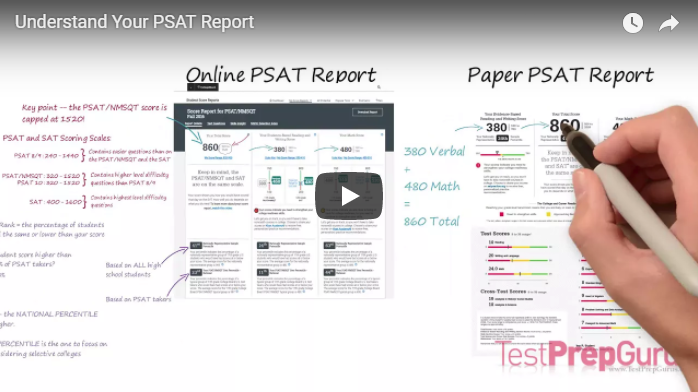
CEO of Test Prep Gurus, Nick Standlea, offers strategies for reducing anxiety in the college admissions process. This talk was given at the National Charity ...

Nick regularly speaks to high school parents on a range of topics, including:

  • SAT vs ACT -- Everything You Need to Know

  • Reducing Anxiety in College Admissions and Standardized Testing

  • 9 Ways to Teach Growth Mindset

  • PSAT and/or Pre-ACT Scoreback Nights

  • LDs and Standardized Testing

Nick is a published author and a former Research Associate at the Quality of Life Research Center at Claremont Graduate University - a think tank that studies education, learning, creativity, and motivation. He is also the founder of Test Prep Gurus. He earned a perfect score on the SAT, but is much more proud of Test Prep Gurus students' many successes and achievements. He holds a BA from Pitzer College and an MBA from the Peter F. Drucker School of Management at Claremont Graduate University.  Nick is also a member of WACAC and a member of the NACAC Orange County College Fair team.

Past engagements include: UC Berkeley, Pitzer College, Claremont Graduate University, Golden West College, Loyola Marymount University, the Western Association of College Counseling (WACAC), National Association of College Counseling (NACAC) college fairs, A Better Chance foundation, The Orange County Private School Association, the National Association of Independent Schools (NAIS), The Webb Schools, Rosary Academy, Hawaii Preparatory Academy, JSerra Catholic High School, Connelly School for Girls, Fusion Academy, Orange Lutheran High School, New Roads School, Newport Harbor High School, Northwood High School, Capo Valley High School, Santa Monica High School, Sage Hill School, and many others.  

Nick Standlea, CEO, Test Prep Gurus, www.PrepGurus.com

Nick Standlea, CEO, Test Prep Gurus, www.PrepGurus.com

Our Newport Beach Branch is in a sweet, new location :)

We are excited to announce that we have moved our Newport Beach branch to a new location.  We had to move in order to accommodate our growth, and we are very excited about the new upgraded digs! 

23 Corporate Plaza Drive, Suite 150, Newport Beach, CA 92660

(Map Link: https://goo.gl/maps/kZzBakCQXbN2

We look forward to meeting with you at our new spot!

Thank you,

The TPG Team

2018 PSAT National Merit Cutoff is... 223 (+1 from last year)

We've received a lot of emails lately asking what the PSAT national merit scholarship semi-finalist cutoff score would be for California this year. The results are in. The semi-finalist cutoff is 223. This is an increase of +1 from last year.

This places California among the toughest states in the country to qualify as a national merit scholarship semi-finalist. Due to that fact that semi-finalists are chosen on a state-by-state basis, it is generally much more difficult to qualify as a semi-finalist in states with large populations. In such states, more students take the PSAT exam, which tends to mean more high-scoring students, which pushes up the cut-off scores for said states. 

If you just missed the cutoff this year (one of our students was in tears yesterday with her PSAT score of 222), try not to worry too much. Any score in the neighborhood of 222 is an incredible achievement.  You might have missed the distinction of being a national merit scholar, but on the other hand, we can state with an extremely high level of confidence that you will score very high on your official SAT or ACT exams. Those high scores will undoubtedly open many doors for you in the college admissions process. So whether or not you can add "national merit scholar" to your resume, your future is extremely bright!

Is the ACT curved?

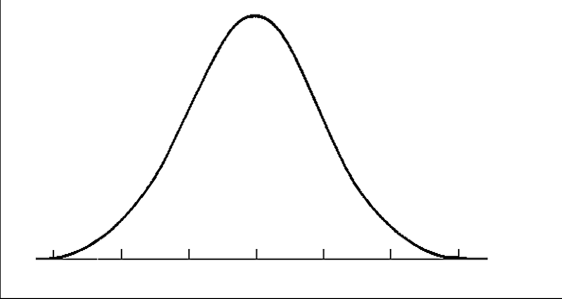
Bell_Curve.gif

Is the ACT curved?  Yes, but not the same way that a test in your geometry or history class might be. It works like this...

The ACT "curve" is designed to correct for minor fluctuations in the difficulty of the test. In essence, when an exam contains a few more difficult questions, students can actually miss a few more problems to achieve a certain score. Likewise, when an exam contains a few more easy questions, students need to answer more of them correctly to achieve the same score. In this way, there is no advantage to taking a test with easier questions (again, you'd have to answer more of them correctly), and no disadvantage to taking a test with harder questions (because you'd be able to miss a few questions).

Before we look at an example, let's define some terms. A "scaled score" is the one you're most likely familiar with. It's the score for each section that ranges from 1-36.

The scaled score is derived from your "raw score", which is the number of questions answered correctly.

Example: suppose that on the ACT math section, you answer 31 questions correctly out of the 60 total. With a raw score of 31, you might receive any one of three different scaled scores: 19, 20, or 21. The scaled score you receive would be determined by how difficult the exam was.

  • For instance, on the April administration of the ACT, you would have received a math score of 19 because the test was a little easier than average. 

  • On the June ACT, you would have received a 20 because the June test was close to average

  • On the December ACT, you would have received a 21 because the December test was harder than average.

Another way to look at it: in order to score a 20 in math, you would need a raw score of 31 on the easier test (April), 30 on the average test (June), and only 29 on the harder test (December).

Please note that the months used in the above example were picked at random. The difficulty of any month's exam is not released to the public ahead of time. A common myth about the ACT curve is that the average test taker should avoid a particular test month if a large group of strong students will be taking the ACT that month, and instead take the test when a large group of weaker students will take the test. The (mistaken) assumption here is that the curve will push down the average student's score in the first situation (large group of strong students) and pull it up in the second situation (large group of weak students). The reality is that the curve is set before the exam is administered because it is based on the difficulty of the questions, not the quality of students taking the test. So even if in a particular month, a large group of strong students all earned perfect 36s, your score would be the same as it would have been if they not taken the test at all. In the same way, a large group of weaker students taking the test will not affect your score.

Bottom line: Take the ACT when it best suits your schedule and you have ample time to concentrate on your preparation for the exam. Don't worry about other students. Their scores will not affect your scores or vice versa. Instead, focus on yourself and what you need to do to reach your scoring potential.  


At Test Prep Gurus we teach students how to raise their ACT and SAT scores so they can reach their goals for college and beyond.

It all starts with 3 steps:

  1. Complete mock ACT and SAT exams.

  2. Schedule a free 15-minute consultation to review your exam results.

  3. Create a 1-on-1 test prep plan to reach your goals for college and beyond.

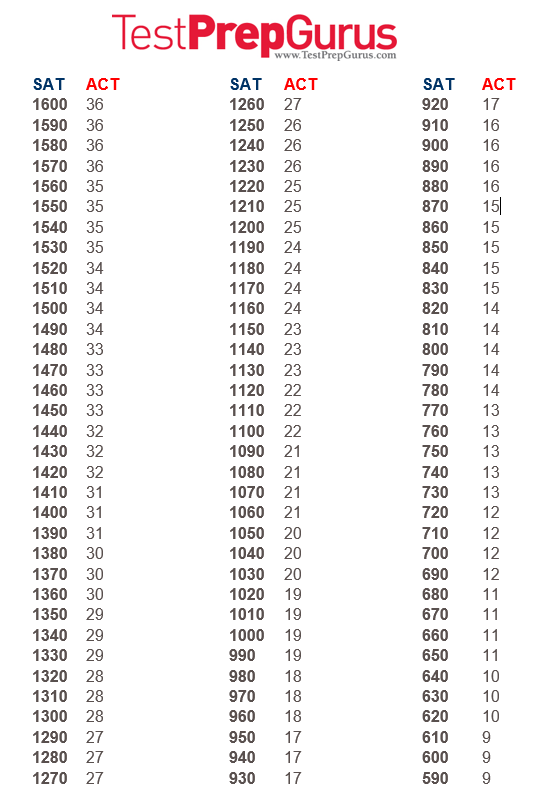
New Table to Translate ACT to SAT Scores, and SAT scores to ACT scores

ACT and SAT have adjusted their concordance table (the chart used for translating scores between the two exams).

The biggest change affects scores on the higher end of the scale (1270 and up on the SAT, 28 and higher on the ACT).

In most instances, the change resulted in a slight downward movement for SAT scores. For example, 1360 on the SAT used to be considered equivalent to 29 on the ACT; on the new table, 1360 is equal to 30. 


SAT to ACT.PNG

5 Things to Consider Before Your Child With Learning Differences Jumps on the Early PSAT Bandwagon

This is a special guest blog post by Marci Miller of the Miller Advocacy Group in Newport Beach, California.  


by Marci Lerner Miller

Miller Advocacy Group

www.milleradvocacy.com

The PSAT/NMSQT, is a preliminary version of the SAT that can prepare students for the real event. Since 1955, high schools have been offering this test to juniors once a year, and the highest scoring students have been eligible to qualify for a National Merit Scholarship. There is good reason to prepare for this test early and prepare well – over $180 million dollars in scholarship funds are given out each year to some of the top 1% of the PSAT test-takers.

You may have noticed that the PSAT isn’t just for high school juniors anymore. After the ACT overtook the SAT as the most popular college admissions test, College Board reacted, in part, by offering a new “Suite of Assessments,” including a PSAT 10 for sophomores and a PSAT 8/9 for even younger students.

Given the high stakes of the SAT and the scholarship potential for those scoring well on the official PSAT, students should take every opportunity to practice, right?  

Not so fast!! If you have a student with learning differences or disabilities who will be taking one of these early assessments, there are a few things you need to know first:


1.  Make Sure Testing Accommodations Are Approved by College Board

BEFORE the PSAT 10

Even if your child has an IEP or a 504 Plan, do not assume that he or she will automatically have accommodations on the PSAT. This requires your school counselor to submit a request to College Board, and many high school counselors wait until students are in 11th grade to make these requests, because the high school counselors have not adjusted their timelines to reflect College Board’s changes.

You may hear from your school that there is no rush, because the PSAT 10 test “does not count.” For some students with disabilities, this is simply incorrect.

Although the PSAT 10 results are not reported to colleges or used for National Merit consideration, the results are still reported to College Board, and this can have some unintended and unfortunate implications for some students who have waited too long to secure their accommodations, or for those who do not yet know they need them.

To be eligible for accommodations, a student has to demonstrate a disability and ALSO a need for the requested accommodations. If your child takes the PSAT (or any College Board exam) without accommodations, and scores in the average or above average range, College Board may decide that your child’s disability does not impact his or her test-taking ability enough to allow accommodations on later testing.

Under the Americans with Disabilities Act (which applies to College Board), a student with a documented disability who has a history of academic success can still be entitled to testing accommodations. However, this is no guarantee that College Board will grant accommodations so that that your child’s SAT score matches his or her school performance or “potential” – depending on the circumstances, they may not.

To be safe, and to avoid what could have a serious impact on the college admissions process, make sure that your son or daughter’s school counselor has all College Board accommodations requests submitted and approved before any testing.

The good news… once accommodations are approved, they can be used on the PSAT, the SAT, the SAT Subject Tests, and AP Exams. There is no need to request accommodations again.


2.  If you suspect a disability or learning issue, WAIT!

Often times, learning issues don’t present themselves until a student begins studying for standardized testing. Bright kids can compensate for ADHD, anxiety, even dyslexia all the way through high school by hard work and short cuts, but when faced with timed testing, their issues surface for the first time. While a determined kid can stay up all night to finish the work that other kids skate through, this same strategy does not work under timed conditions.

A skilled test tutor is often the first person to recognize learning issues and may refer a student for educational testing. For the same reasons stated above, wait until any assessments or evaluations have been completed, school accommodations have been put into place, and College Board approvals have been granted before having your child take the PSAT. After all, these students, in particular, are very bright and hard-working, and deserve the best possible opportunities.


3. Early Test Anxiety – Is it Worth it?

On the other end of the scale, your student may not perform as hoped, and this may introduce test anxiety to the picture long before it is necessary. More and more teenagers are suffering from anxiety, and it may not be a coincidence that these same teenagers have been subjected to earlier and more standardized testing than ever before. It is not uncommon for students who struggle with learning disorders and ADHD to also suffer from depression or anxiety. While the angst is expected in high school, maybe middle school is just too early for your child to begin the college admissions journey.

All students must eventually learn strategies to manage their test anxiety, but make sure that your child with learning issues is mature enough before taking the early PSAT, or when the real thing comes along, he or she may suffer more.


4. Work with The School Counselor for PSAT 8/9 Accommodations

If your child has school accommodations, he or she can use those accommodations on the PSAT 8/9 without requesting prior approval from College Board. However, you must confirm these accommodations in advance, and certain accommodations like large-type or Braille test books must be ordered by the school before the firm deadline.


5. Plenty of Other Opportunities to Practice the PSAT

For many students, becoming engaged in the testing process early will keep them on target for college and career readiness. However, for parents of students with disabilities or suspected learning differences, taking advantage of College Board’s early testing may not be worth the potential risks.

This should not stop you from making sure your child is just as prepared for the PSAT and SAT when the time arrives! There are other ways to practice for the PSAT and SAT, and other college entrance exams. Test prep companies (such as Test Prep Gurus) regularly administer practice tests. The College Board also offers free sample tests through its website.


4 Ways to Teach a Growth Mindset

People with a "fixed mindset" think that intelligence is static—that they have a certain amount of it which cannot really be changed. Other people have a "growth mindset." They think intelligence is malleable—that it can be developed and increased through hard work.

Students who have a growth mindset tend to do better in school (especially when they encounter academic difficulties) as well as on the SAT and ACT.  However, cultivating a growth mindset in students is actually much more challenging than it might seem.

Below, are four lessons we have learned about how to cultivate a growth mindset in teenagers. 

  • Do NOT tell students to have a growth mindset

    The first rule of growth mindset is that you do not talk about growth mindset. Teenage students often have a negative reaction to being told how to think. They respond much more positively to being shown that something works with objective evidence. 

  • Do not tell students to "just try harder"

    Most students, especially those who are struggling, have heard "just try harder." This is rarely ever helpful to students. Instead of that old line, explain to students why they should put in extra effort (again, use objective evidence to back all claims) and specifically how to deploy that effort. Sometimes a better strategy is more useful than simply increasing effort.

  • Celebrate mistakes!

    Most students fear making mistakes. They often think mistakes are an indication of a lack of intelligence. But research shows that mistakes are a critical part of learning. Having to work through a difficult problem and try different strategies is the optimum method for learning to improve on standardized exams (and in other areas of life). Encourage your student to embrace mistakes and show them how to learn from them. As one of our students once told us: "Fail...fail better...fail better...succeed."

  • Praise the process, not the person

    Our first impulse is often to praise students for being smart. This sends the wrong message. When students later encounter a setback they conclude: "If my past success meant I was smart, my current struggle means I'm not smart." Instead, praise students for their effort and hard work. This implies that you value hard work and that effort is the root cause of success.


Speaking of growing, the next step is to start the process of growing your ACT or SAT scores.

At Test Prep Gurus we teach students how to raise their ACT and SAT scores so they can reach their goals for college and beyond.

It all starts with 3 steps:

  1. Complete mock ACT and SAT exams.

  2. Schedule a free 15-minute consultation to review your exam results.

  3. Create a 1-on-1 test prep plan to reach your goals for college and beyond.

Math Formulas We Wish Every Student Had Memorized

Want to score higher on SAT and ACT math sections? Memorize these formulas before you begin prepping. 


1. Average or mean = Sum of values / Number of values

Ex: (10 + 12 + 14 + 16) / 4 = 13


2. Probability = Target outcomes / Total outcomes

Used to calculate the chances of something occurring from a set of possible outcomes.

Ex: A jar contains five blue marbles, five red marbles, and ten white marbles. What is the probability of picking a red marble at random?

5 / 20 = .25 or 25%


3. Quadratic Formula: x = −b ± √b²-4ac/2a

Used for determining the x-intercepts of a quadratic (parabolic) equation.

Ex: A = 1, B = -4, C = 4

  • x = -4 ± √4² – 4 (1)(4) / 2(1)

  • x = -4 ± √ 16 – 4(4) / 2

  • x = -4 ± √16 – 16 / 2

  • x = -4 ± √ 0 / 2

  • x = -4 / 2

  • x = -2


4. Distance Formula: d=√(x₁ – x₂)² + (y₁ – y₂)²

Ex. Find the distance between points (6, 6) and (2, 3)

  • d=√(6 – 2)² + (6 – 3)²

  • d=√(4)² + (3)²

  • d=√16 + 3

  • d=√25

  • d = 5


5. Slope Formula: Slope = y₂ – y₁ /  x₂ – x₁

Calculate the slope (angle) of a line that connects two points on a plane.

Ex: Coordinates = (-2, -1) (4, 3)

  • s = 3 – (-1) / 4 – (-2)

  • s = 4 / 6

  • s = 2 / 3


6. Slope Intercept: y=mx+b

Formula the defines a line on a plane, given a known slope and y-intercept.

Ex: Slope = 2, Intercept point (0,3)

  • y = 2x+3


7. Midpoint Formula: (x₁+x₂) / 2, (y₁+y₂) / 2

Calculates the midpoint between to points on a plane.

Ex: Find the midpoint between (-1, 2) and (3, -6)

  • (-1 + 3) / 2, (2 + -6) / 2

  • 2 / 2, -4 / 2

  • Midpoint (1, -2)


8. Area of Triangle: area = (1/2) (base) (height)

Calculate the total area within a triangle based on the lengths of the sides.

Ex: Base = 5, Height = 8

  • a = 1/2 (5)(8)

  • a = 1/2 (40)

  • a = 20


9. Pythagorean Theorem: a²+b²=c²

Used to calculate the length of an unknown side of a right triangle, given two sides are known.

Ex: a = 3, b = 4

  • c² = 3² + 4²

  • c² = 9 + 16

  • c² = 25

  • c = √25

  • c = 5


10. Area of Rectangle: area = length x width

Calculates the total area within a rectangle shape.

Ex: length = 5, width = 2

  • a = 5 x 2

  • a = 10


11. Area of Parallelogram: area = base x height

Calculates the total area within a parallelogram.

Ex: base = 6, height = 12

  • a = 6 x 12

  • a = 72


12. Area of Circle: π * r²

Calculates the total area within a circle.

Ex: radius = 4

  • a = π x 4²

  • a = π x 16

  • a = 50.24


13. Circumference of Circle: circumference = 2π *  r

Calculate the length of the outline of a circle.

Ex: radius = 7

  • c = 2π x 7

  • c = 43.98


14. Sine (SOH): Sine = opposite / hypotenuse

A trigonometric identity that represents the relative sizes of the sides of a triangle and can be used to calculate unknown sides or angles of the triangle.

Ex: opposite = 2.8, hypotenuse = 4.9

  • s = 2.8 / 4.9

  • s = 0.57


15. Cosine (CAH): Cosine = adjacent / hypotenuse

A trigonometric identity that represents the relative sizes of the sides of a triangle and can be used to calculate unknown sides or angles of the triangle.

Ex: adjacent = 11, hypotenuse = 13

  • c = 11 / 13

  • c = 0.85


16. Tangent (TOA): Tangent = opposite / adjacent

A trigonometric identity represents the relative sizes of the sides of a triangle and can be used to calculate unknown sides or angles of the triangle.

Ex: opposite = 15, adjacent = 8

  • t = 15 / 8

  • t = 1.87

At Test Prep Gurus we teach students how to raise their ACT and SAT scores so they can reach their goals for college and beyond.

It all starts with 3 steps:

  1. Complete mock ACT and SAT exams.

  2. Schedule a free 15-minute consultation to review your exam results.

  3. Create a 1-on-1 test prep plan to reach your goals for college and beyond.

Do Excellent Grades = High SAT & ACT Scores?

No, they don't. Students with excellent grades are more likely to score higher on the SAT and ACT.  But many students with high GPAs do not score as high on standardized exams as they presumed they would. 

It may surprise you to know that the material on the SAT and ACT exams often does not align with what students learn in school (for example, students are rarely asked to write, edit, and submit an entire essay in under forty minutes). ACT and College Board work quite hard to align their assessments with what is taught in high school. But as you might imagine, it is extraordinarily difficult to create one standardized exam that assesses what millions of students across the country (and the world) learn in high school.

The key is that students should not fear the disconnect between the material they learn in school and the questions they'll face on the ACT and SAT. Instead, they should recognize the exams for what they are -- stepping stones on the path to their goals for the future.The SAT and ACT reward students' hard work and dedication. With the right instructors, the right system, and a little bit of elbow grease, students can improve their scores dramatically. 

Viewed in this context, the SAT and ACT are no longer assessments -- they are opportunities. 


At Test Prep Gurus we teach students how to raise their ACT and SAT scores so they can reach their goals for college and beyond.

It all starts with 3 steps:

  1. Complete mock ACT and SAT exams.

  2. Schedule a free 15-minute consultation to review your exam results.

  3. Create a 1-on-1 test prep plan to reach your goals for college and beyond.

Test Prep: 8 reasons why 1-on-1 is more effective than a class

We are often asked why 1-on-1 instruction for the SAT or ACT is superior to classroom instruction. Here are just few of the reasons: 

1. Students will have the full attention of their instructors to maximize specific strengths and address areas of improvement,

2. Instructors take time to articulate and understand the student’s short and long term goals and personalize instruction to reach those goals,

3. The instruction is customized to the student’s particular character, personality, strengths, weaknesses, needs, and goals,

4. Students are paired with instructors based on their particular needs and personalities,

5. Students work more efficiently and effectively at their own pace,

6. The test prep schedule can be tailored to students’ busy lives,

7. Students receive mental and emotional support to ameliorate testing anxiety and stress,

8. By monitoring a student’s progress every step of the way, the instructors are able to help students achieve unparalleled success.

Contact us today to learn more about 1-on-1 preperation